Showing posts with label Sauropods. Show all posts

Thursday, May 30, 2019

Walk This Way

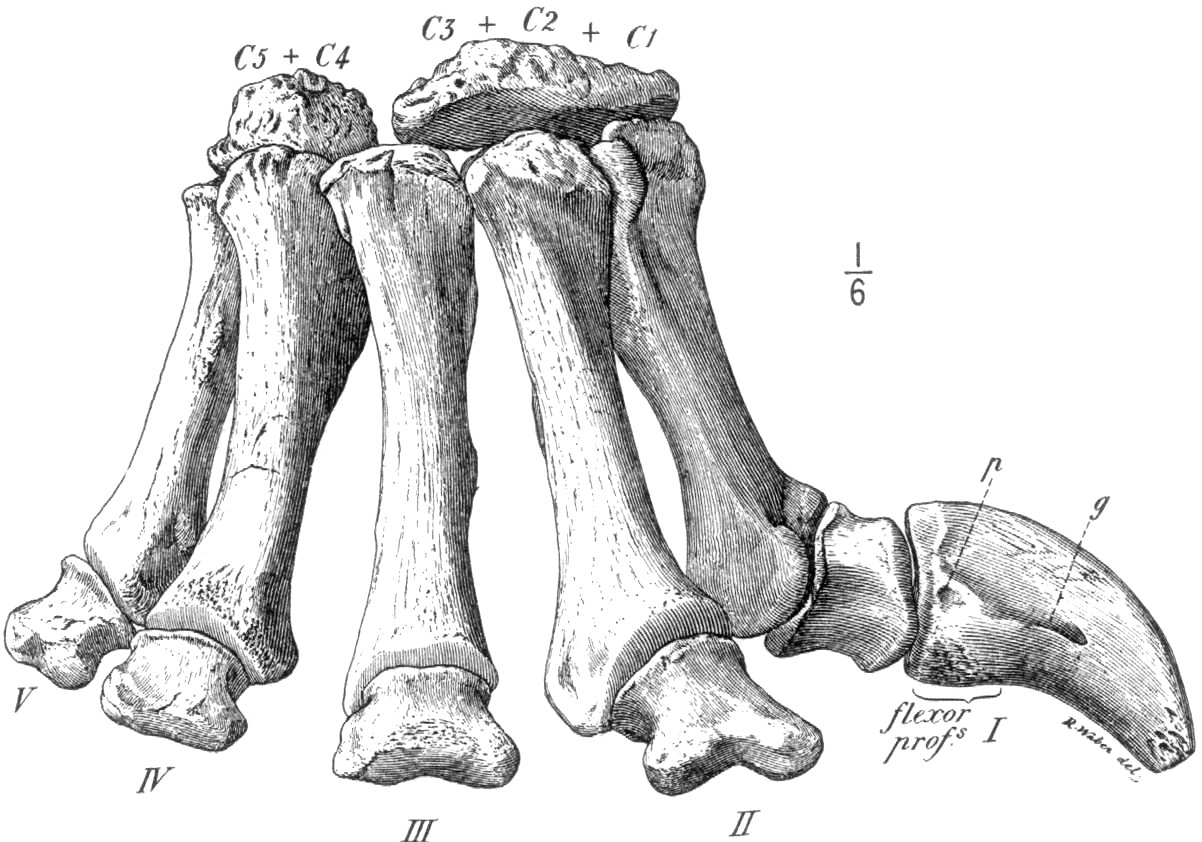
The right manus of Camarasaurus. Note the columnar arrangement and virtual absence of fingers.
Late last year, I introduced you all to the Lessemsauridae, a group of near-sauropod "prosauropods" that grew unreasonably large—up to 12 tons in Ledumahadi mafube. There’s some disagreement about the posture of these enormous animals: in true, blue Sauropoda, the forelimbs are columnar, the hands are pronated, the weight is bore on the fingertips, and there is a reduction in phalanges and claws. This arrangement is present to some degree even in the earliest true sauropods like Melanorosaurus and Barapasaurus.

Tuesday, October 23, 2018

They Might Be Giants

Ingentia prima by Jorge Gonzalez
Two recent news stories perked my interest recently—the descriptions of two new non-sauropod sauropodomorphs: Ingentia prima from the Late Triassic of Argentina and Ledumahadi mafube from the Early Jurassic of South Africa. Together, these animals (and two others which I’ll get to) form a clade of non-sauropod sauropodomorphs that achieved gigantism independently from true, blue sauropods, which is intriguing for a number of reasons.

Wednesday, September 14, 2016

Titanosaur Heads

Illustration by "Stocktrek Images, Inc."
Sauropods are among the most familiar of all dinosaurs—consider that pretty much everybody knows Brontosaurus or Brachiosaurus. But what may surprise you is that most sauropods are known from fairly scant remains—isolated vertebrae or pieces of the axial skeleton. Brontomerus was named for, essentially, an incomplete ilium and scapula. Argentinosaurus, one of the largest tetrapods that ever lived, was named for a series of vertebrae, ribs, and a fibula. But you know what’s most often missing from a sauropod skeleton? The head.