Showing posts with label dinosaurs. Show all posts

Thursday, September 24, 2020

Slightly More Hopeful Dinosaurs

Lewisuchus--basalmost ornithischian? (from Ezcurra et al., 2019)

Dear me, it’s been awhile, hasn’t it? My tardiness in keeping this blog going has not been entirely intentional; 2020’s been a year for the records? I only hope it ends on December 31st and doesn’t continue on in some space-time warping extension into December 32nd. Nonetheless, I am motivated today to inform you all about a paper that brings together several topics I’ve written about in years past: silesaurids, Pisanosaurus, and the Triassic Ornithischian Crisis. Below, I will offer the briefest of recaps, but hit those links if you want a more complete picture.

Tuesday, October 23, 2018

They Might Be Giants

Ingentia prima by Jorge Gonzalez
Two recent news stories perked my interest recently—the descriptions of two new non-sauropod sauropodomorphs: Ingentia prima from the Late Triassic of Argentina and Ledumahadi mafube from the Early Jurassic of South Africa. Together, these animals (and two others which I’ll get to) form a clade of non-sauropod sauropodomorphs that achieved gigantism independently from true, blue sauropods, which is intriguing for a number of reasons.

Wednesday, May 24, 2017

The Long, Complicated History of Appalachian Ceratopsians

North America during the Campanian
The title is a joke. Finding ceratopsian remains east of Texas is an incredibly recent phenomenon. Oh sure, there are plenty of (fragmentary) dinosaurs known from the eastern half of the United States, but those taxa tend to be tyrannosauroids, nodosaurs, ornithomimids, and hadrosaurs. I should mention at this point that, during much of the Late Cretaceous, North America was cleaved into three islands by the presence of a shallow interior sea called the Western Interior Seaway (WIS): Laramidia to the west, Nunavut to the north, and Appalachia to the east. Laramidia’s eastern north-south shoreline is where we get most of North America’s dinosaurs—Alberta, Montana, Utah, and (to a lesser extent) Texas are all hotbeds of dinosaur action, and that includes ceratopsians.

Thursday, July 21, 2016

Book Review: Recreating an Age of Reptiles

I think we’re all familiar with the work of one Dr. Mark P. Witton. 

If you follow Mesozoic paleontology at all, you’ve probably read some of his papers (this one among many others) and you probably own his wonderful Pterosaurs book. Perhaps you even visited his inspiring 2010 pterosaur show in London. I have to imagine you read his excellent paleo-blog, too. 

Heck, maybe you’ve met him at SVP, perhaps back in 2009, when mutual friend Julia Heathcote introduced you but you were too intimidated and tongue-tied to say anything intelligent. I can tell you, from that brief encounter, that Dr. Mark P. Witton is the only person I’ve ever known who can successfully pull of an ascot.

Wednesday, May 13, 2015

Scansoriopterygid FAQ

Sorry I'm a bit late to this party. You've probably already read Darren Naish's and Jaime Headden's excellent takes on Yi qi, but I'm going to try something a little different. It's a FAQ. Let me know if you like this format or not for covering news.

So I heard there’s a new dinosaur in town!

That's no sauropodomorph...

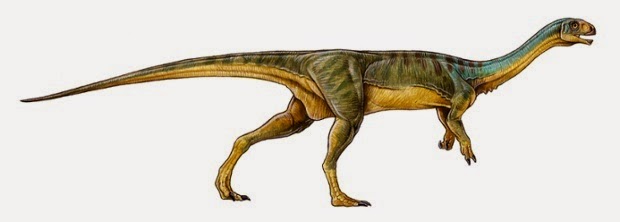
Indeed there is! It’s a basal tetanurine from Chile named…Chilesaurus. It’s weird because it’s a theropod that has reverse-engineered some sauropodomorph and ornithischian features.

Wait, what? Did it have bat wings?

Oh, you’re talking about Yi qi, from China, also announced in two weeks ago.

Wednesday, January 21, 2015

Aquilops in My Hand

Aquilops americanus, by the incomparable Brian Eng.

There's a new basal neoceratopsian in town. It's from Montana's Cloverly Formation, and it's a raccoon-sized critter that is the oldest definitive horned dinosaur in North America: Aquilops americanus, an eagle-faced cutie. It was described by Andy Farke, Desmond Maxwell, Richard Cifelli, and Matthew Wedel. Andy wrote about it at The Integrative Paleontologist, and Matt Wedel has been covering it extensively--as well as public outreach--at SV-POW. Check it all out.

Monday, November 10, 2014

Laramidian Endemism: Part 1

Every few years, the wife and I will spend Christmas away from Alaska with her family, in Kansas. Now, the Sunflower State may not be the most exciting place to spend the holidays, but it's usually warmer than it is in Anchorage. It's also, from my point of view, a lot more geologically interesting. Now, of course, Alaska is home to about a million mountain ranges, glaciers, and volcanoes. Indeed, my state is largely a conglomeration of chunks of continental crust, earthquakes, and volcanic activity. In its own way, Alaska is the MOST interesting state, geologically speaking. But Kansas is basically made of limestone and chalk. Alaska's Mesozoic fossil record is only impressive when you look past the fact that it is made up of hundreds of bits, pieces, and chunks of bone.

Tuesday, November 4, 2014

Deinocheirus > Spinosaurus

There’s a new giant, sail-backed, piscivorous theropod in town.

Just a month after Ibrahim et al. (2014) revealed their new interpretation of Spinosaurus aegypticus, Lee et al. have done one better: they've published a description of Deinocheirus mirificus, one of the most mysterious dinosaurs ever found. For those not keeping score at home, Deinocheirus was discovered in 1965 during a Polish-Mongolian expedition into the southern Gobi Desert. Unfortunately, all that was found was a pair of enormous arms—indelibly seared into the minds of every man, woman, and child who opened a dinosaur book over the next forty years. It was pretty easy to see that Deinocheirus was an ornithomimid, but it must have been absolutely enormous. It wasn't until 2006 and 2009 that more skeletal material was discovered—both in the field and in a private collection. For more on this, Ed Yong and Brian Switek have fascinating write-ups about the discovery and its history.

Monday, October 20, 2014

Taxonomic Messes

In his recent Princeton Field Guide to Dinosaurs, Greg Paul did something interesting: he sank most of the Centrosaurinae into Centrosaurus. Thus, instead of Styracosaurus albertensis, you now have Centrosaurus albertensis. Where once there was Pachyrhinosaurus lakustai, there is now only Centrosaurus lakustai. This seems ridiculous on the face of it, but Paul's justification is not entirely off-kilter: he surmises that the Centrosaurinae exhibits as much or less variation than is found between different species of Varanus. But that comparison is, in itself, completely arbitrary. The taxonomy of living animals--and especially living reptiles--is dictated by an entirely separate group of specialists. If paleontologists were in charge of Varanus, it might well be divided into separate genera. Herpetologists (and Greg Paul) are especially fond of subgenera, whereas as I believe that subgenera are confusing and unnecessary.

Sunday, October 12, 2014

Place Name-o-saurus

Albertosaurus, a tyrannosaur from Alberta, in case that wasn't clear.

All of these fossil animal names have something in common. Can you guess what it is?

Albertosaurus, Albertaceratops, Albertonykus, Albertonectyes, Edmontosaurus, Edmontonia, Agujaceratops, Coahuilaceratops, Judiceratops, Utahraptor, Utahceratops, Alaskacephale, Sinosauropteryx, Sinornithosaurus, Sinovenator, Sinocalliopteryx, Sinornis, Sinoceratops, Huaxiagnathus, Huaxiaosaurus, Qianzhousaurus, Zhuchengceratops, Zhuchengtyrannus, Montanoceratops, Argentinosaurus, Nigersaurus, Aegyptosaurus, Brasilotitan, Gondwanatitan, Panamericansaurus, Gobisaurus, Afrovenator, Antarctopelta, Europelta, Europasaurus, Hungarosaurus, Hatzegopteryx, Santanadactylus, Santanaraptor, Santanachelys

Monday, October 6, 2014

Spinosaurus-world Problems

Spinosaurus aegypticus, lord of the Kem Kem river system.

September 12th saw the publication of Ibrahim et al.’s new reconstruction of Spinosaurus aegypticus, surely one of the most famous and mysterious of all dinosaurs. The authors designate a neotype, assign a bunch of previously indeterminate material to S. aegypticus, synonymize “Spinosaurus maroccanus” and “Sigilmassassaurus brevicollis” into S. aegypticus, and offer up a bizarre interpretation of the whole animal. No longer confined to wading in rivers and snatching up fish a la Suchomimus, Spinosaurus is now a proper semi-aquatic dinosaur that the authors compare to early whales. Aside from being published in Science, National Geographic appears to be paying the bills and fabricated a massive skeletal reconstruction and life-size model. As can be expected, there was much media fanfare surrounding the publication and public unveiling.