Friday, December 25, 2015

Monkey Lizards of the Triassic

Another exciting entry in the "Primer" series (which started with hupehsuchians)! Again, we're tackling a Triassic oddity. There are lots to choose from. Indeed, I sense a theme!

The Late Triassic was an exciting time in the history of life on Earth. Ecosystems were finally in full recovery after the brutal Permio-Triassic Extinction in which life nearly died, and the ancestors of modern groups were becoming established—this is where you find the great-great granddaddies of birds, mammals, and crocodilians. However, even though the world’s food webs and the roles within it were similar to today, the actual composition of those roles was much different. Mother Nature was going through a period of divine inspiration: the predator guild was ruled by large, vicious (distant) relatives of crocodiles—Postosuchus, Carnufex, and Teratosaurus—preyed on their own herbivorous relatives, the armored aetosaurs. These critters looked like a cross between an armadillo and a crocodile, but grubbed around on the ground for plants. The other big role in the herbivore guild went to the dicynodonts, therapsid holdovers from the Permian with tusked, toothless, beaked jaws, some of which grew to be the size of cows.

Tuesday, October 6, 2015

The Secret (Fossil) Origin of the TMNT

Yes, even these Ninja Turtles.

What are turtles?

Everybody knows what turtles are. They're those reptiles that have enormous shells. Most turtles live in freshwater lakes and streams, but others are entirely terrestrial (tortoises) and a few are specialized for a marine life. The upper half of the shell is called the carapace and the "belly" shell is called the plastron. They lay a ton of eggs so that a few of the babies will survive to adulthood. Snapping turtles are really bad-ass and can bite your finger off.

Wednesday, May 13, 2015

Scansoriopterygid FAQ

Sorry I'm a bit late to this party. You've probably already read Darren Naish's and Jaime Headden's excellent takes on Yi qi, but I'm going to try something a little different. It's a FAQ. Let me know if you like this format or not for covering news.

So I heard there’s a new dinosaur in town!

That's no sauropodomorph...

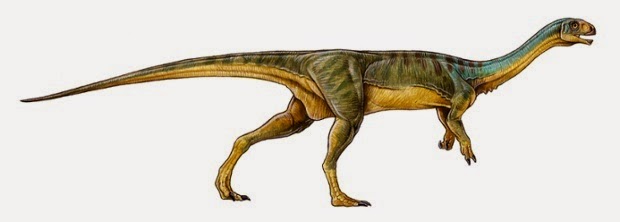
Indeed there is! It’s a basal tetanurine from Chile named…Chilesaurus. It’s weird because it’s a theropod that has reverse-engineered some sauropodomorph and ornithischian features.

Wait, what? Did it have bat wings?

Oh, you’re talking about Yi qi, from China, also announced in two weeks ago.

Sunday, March 22, 2015

Whale Lizards of the Triassic, Part I

How many modern marine reptiles can you name? I count two, broadly speaking: sea turtles and marine iguanas. Back in the Cretaceous, there were a few others. Many of the world’s oceans hosted the deadly mosasaurs, which were essentially marine-adapted monitor lizards. You also had the familiar but puzzling plesiosaurs; with their long necks, tiny heads, and wide rounded bodies, it’s still difficult to determine exactly how they made their living. Also still going strong were the ichthyosaurs—dolphin-shaped marine lizards with huge eyes and a taste for cephalopods. Marine iguanas weren’t a thing yet, but sea turtles were actually more diverse (and bigger) than they are today.

Wednesday, January 21, 2015

Aquilops in My Hand

Aquilops americanus, by the incomparable Brian Eng.

There's a new basal neoceratopsian in town. It's from Montana's Cloverly Formation, and it's a raccoon-sized critter that is the oldest definitive horned dinosaur in North America: Aquilops americanus, an eagle-faced cutie. It was described by Andy Farke, Desmond Maxwell, Richard Cifelli, and Matthew Wedel. Andy wrote about it at The Integrative Paleontologist, and Matt Wedel has been covering it extensively--as well as public outreach--at SV-POW. Check it all out.

Tuesday, November 25, 2014

Laramidian Endemism, Part 2

Last week we saw that, during a good portion of the Late Cretaceous, North America was divided into two unequal halves by the shallow Western Interior Seaway (WIS). Those dinosaurs on western Laramidia were boxed between mountains to the west and the fluctuating coastline of the WIS to the east. They lived on a narrow, vertical strip of land running from Alaska’s North Slope to Mexico. On the other hand, everybody had beachfront property. We can’t say much about Appalachia’s Mesozoic composition, as much of its fossil-bearing rocks were destroyed by the last Ice Age. However, tyrannosaurs and hadrosaurines who were isolated prior to the formation of the WIS evolved along different lines than their western relatives. Dryptosaurus and Appalachiosaurus are the island continent’s aberrant tyrannosaurs. Hadrosaurus and a few potentially dubious genera (Lophorhothon, Hypsibema) represent the area’s hadrosaurine population. It’s ironic that, despite the area’s drastic surface area deficit, Laramidia is ridiculously rich in dinosaur fossils whereas Appalachia is not at all.

Monday, November 10, 2014

Laramidian Endemism: Part 1

Every few years, the wife and I will spend Christmas away from Alaska with her family, in Kansas. Now, the Sunflower State may not be the most exciting place to spend the holidays, but it's usually warmer than it is in Anchorage. It's also, from my point of view, a lot more geologically interesting. Now, of course, Alaska is home to about a million mountain ranges, glaciers, and volcanoes. Indeed, my state is largely a conglomeration of chunks of continental crust, earthquakes, and volcanic activity. In its own way, Alaska is the MOST interesting state, geologically speaking. But Kansas is basically made of limestone and chalk. Alaska's Mesozoic fossil record is only impressive when you look past the fact that it is made up of hundreds of bits, pieces, and chunks of bone.

Tuesday, November 4, 2014

Deinocheirus > Spinosaurus

There’s a new giant, sail-backed, piscivorous theropod in town.

Just a month after Ibrahim et al. (2014) revealed their new interpretation of Spinosaurus aegypticus, Lee et al. have done one better: they've published a description of Deinocheirus mirificus, one of the most mysterious dinosaurs ever found. For those not keeping score at home, Deinocheirus was discovered in 1965 during a Polish-Mongolian expedition into the southern Gobi Desert. Unfortunately, all that was found was a pair of enormous arms—indelibly seared into the minds of every man, woman, and child who opened a dinosaur book over the next forty years. It was pretty easy to see that Deinocheirus was an ornithomimid, but it must have been absolutely enormous. It wasn't until 2006 and 2009 that more skeletal material was discovered—both in the field and in a private collection. For more on this, Ed Yong and Brian Switek have fascinating write-ups about the discovery and its history.

Monday, October 20, 2014

Taxonomic Messes

In his recent Princeton Field Guide to Dinosaurs, Greg Paul did something interesting: he sank most of the Centrosaurinae into Centrosaurus. Thus, instead of Styracosaurus albertensis, you now have Centrosaurus albertensis. Where once there was Pachyrhinosaurus lakustai, there is now only Centrosaurus lakustai. This seems ridiculous on the face of it, but Paul's justification is not entirely off-kilter: he surmises that the Centrosaurinae exhibits as much or less variation than is found between different species of Varanus. But that comparison is, in itself, completely arbitrary. The taxonomy of living animals--and especially living reptiles--is dictated by an entirely separate group of specialists. If paleontologists were in charge of Varanus, it might well be divided into separate genera. Herpetologists (and Greg Paul) are especially fond of subgenera, whereas as I believe that subgenera are confusing and unnecessary.

Sunday, October 12, 2014

Place Name-o-saurus

Albertosaurus, a tyrannosaur from Alberta, in case that wasn't clear.

All of these fossil animal names have something in common. Can you guess what it is?

Albertosaurus, Albertaceratops, Albertonykus, Albertonectyes, Edmontosaurus, Edmontonia, Agujaceratops, Coahuilaceratops, Judiceratops, Utahraptor, Utahceratops, Alaskacephale, Sinosauropteryx, Sinornithosaurus, Sinovenator, Sinocalliopteryx, Sinornis, Sinoceratops, Huaxiagnathus, Huaxiaosaurus, Qianzhousaurus, Zhuchengceratops, Zhuchengtyrannus, Montanoceratops, Argentinosaurus, Nigersaurus, Aegyptosaurus, Brasilotitan, Gondwanatitan, Panamericansaurus, Gobisaurus, Afrovenator, Antarctopelta, Europelta, Europasaurus, Hungarosaurus, Hatzegopteryx, Santanadactylus, Santanaraptor, Santanachelys